

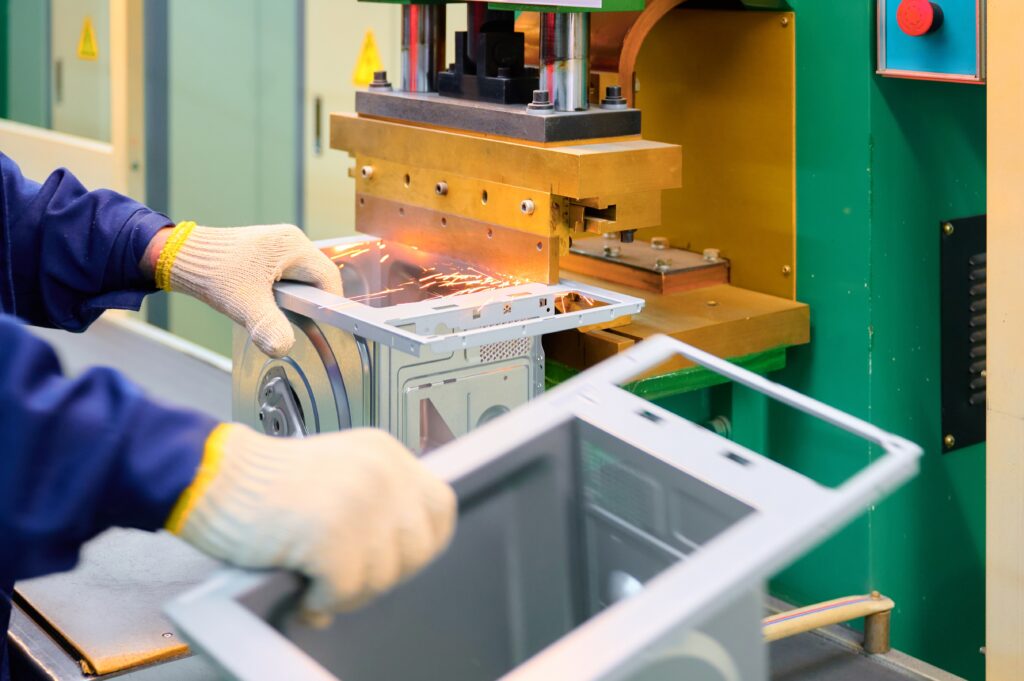
Appliance manufacturing components face several challenges, including maintaining durability, controlling costs, and ensuring consistent quality at high volumes. Appliance component manufacturing challenges often arise from balancing performance requirements with production efficiency, making supplier capability and process control critical for reliable appliance OEM production.
Key Challenges in Appliance Manufacturing Components
- Maintaining durability under repeated use
- Controlling cost while meeting performance requirements
- Ensuring consistency across high volume appliance parts
- Managing supply chain reliability
- Meeting tight tolerances for proper assembly
These challenges directly impact both product performance and manufacturing efficiency.
Durability Requirements for Appliance Metal Components
Durability is a primary requirement for metal parts appliances. Components must withstand repeated use, environmental exposure, and mechanical stress over the product lifecycle.
Key Durability Considerations
- Resistance to wear and fatigue
- Structural integrity under load
- Corrosion resistance in humid or high-temperature environments
Durable metal components appliances are essential for maintaining product reliability and reducing warranty claims. Poor durability leads to early failure and increased long-term costs.
For OEM engineers, selecting the right materials and forming processes is critical to meeting durability requirements.
Cost Pressures in Appliance Manufacturing
Cost pressure is a constant factor in appliance OEM production. Manufacturers must reduce cost without compromising quality or performance.
Cost Challenges Include
- Pressure to reduce piece price
- Increasing material and labor costs
- Need for efficient high-volume production
Balancing cost and performance requires a strategic approach to appliance manufacturing components. Focusing solely on upfront cost can lead to higher total cost due to quality issues or inefficiencies.
An experienced OEM appliance supplier can help identify cost-saving opportunities without sacrificing performance.
Managing High-Volume Production Demands
Appliance manufacturing relies heavily on high volume appliance parts production. Consistency becomes more challenging as production scales.
Key Challenges in High-Volume Production
- Maintaining tight tolerances across large runs
- Ensuring repeatable quality
- Preventing variation between batches
High-volume production requires stable processes and reliable equipment. Without proper control, variation increases, leading to rework and delays.
For sourcing teams, selecting a supplier capable of consistent output is critical to maintaining production schedules.
Supplier Reliability and Consistency
Supplier performance plays a significant role in addressing appliance component manufacturing challenges. Inconsistent suppliers create risk across production.
Risks of Unreliable Suppliers
- Missed delivery timelines
- Variable part quality
- Increased inspection and rework
An OEM appliance supplier must provide consistent quality, predictable lead times, and scalable production capabilities.
Reliable suppliers reduce risk and improve overall production efficiency.
Solutions for Improving Efficiency and Consistency
Addressing appliance manufacturing components challenges requires a combination of process control, supplier alignment, and production optimization.
Key Solutions
- Process Standardization
Ensures consistent output across production runs. - Precision Forming Techniques
Improves dimensional accuracy and repeatability. - Integrated Manufacturing Capabilities
Reduces variability between processes. - Quality Control Systems
Detect and prevent defects early in production.
These solutions help reduce variation and improve efficiency in appliance OEM production.
Step-by-Step Framework for Addressing Manufacturing Challenges
A structured approach helps OEM teams manage appliance component manufacturing challenges effectively.
1. Define Performance Requirements
Identify durability, tolerance, and environmental requirements for components.
2. Evaluate Material and Design
Select materials and designs that support both performance and manufacturability.
3. Align with Manufacturing Processes
Ensure compatibility with roll forming, stamping, and fabrication methods.
4. Validate Production Processes
Test production conditions to confirm consistency and quality.
5. Monitor and Optimize Production
Implement continuous improvement to maintain efficiency and reduce variation.
This framework supports consistent production of appliance manufacturing components while minimizing risk.
Improving Performance Through Process Optimization
Manufacturing processes directly impact the performance of metal parts appliances. Optimizing these processes improves both quality and cost efficiency.
Key Benefits of Optimization
- Reduced scrap and rework
- Improved consistency across high volume appliance parts
- Lower overall production costs
Process optimization ensures that appliance manufacturing components meet both performance and cost targets.
Supporting Appliance OEM Production with Mills Products
Mills Products provides manufacturing solutions tailored to the needs of appliance OEM production. With capabilities in roll forming, precision metal stamping, and fabrication, Mills Products delivers high-volume, durable metal components appliances.
Key strengths include:
- Consistent production of high volume appliance parts
- Tight tolerance control for reliable assembly
- Cost-effective manufacturing processes
This approach supports OEM appliance suppliers in meeting performance, cost, and scalability requirements.
For sourcing teams evaluating long-term partners, Mills Products provides the reliability and consistency needed for appliance manufacturing components.
FAQ: Appliance Manufacturing Components
What are the main challenges in appliance component manufacturing?
Key challenges include maintaining durability, controlling cost, ensuring consistency, and managing high-volume production.
Why is durability important in appliance components?
Durable components ensure long product life, reduce failures, and minimize warranty costs.
How can manufacturers reduce costs without sacrificing quality?
By optimizing processes, selecting the right materials, and working with reliable suppliers.
What role does high-volume production play in appliance manufacturing?
High-volume production requires consistent processes to maintain quality and meet demand.
How do OEM appliance suppliers ensure consistency?
Through standardized processes, precision forming, and quality control systems.
Conclusion
Appliance manufacturing components present unique challenges related to durability, cost, and high-volume production. Addressing these challenges requires reliable suppliers, optimized processes, and consistent quality control.
To improve efficiency and ensure consistent production, submit an RFQ and discuss your appliance component needs with Mills Products.