

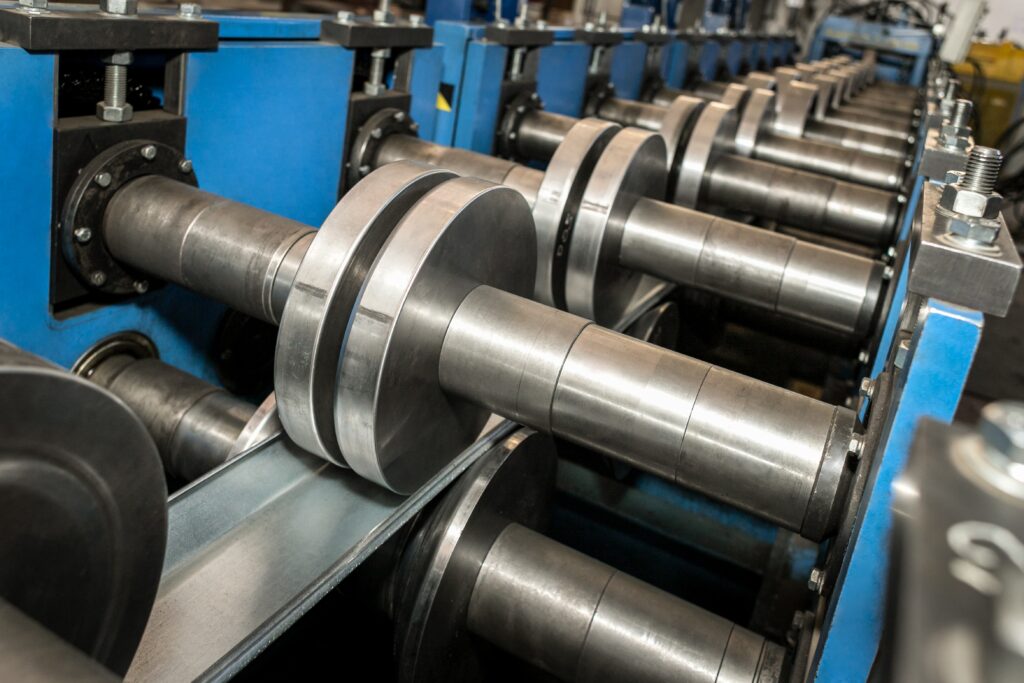
Roll forming services in high-volume manufacturing are a continuous metal forming process used to produce consistent, tight-tolerance OEM metal components at scale. This method enables manufacturers to efficiently produce long, complex profiles with minimal waste, making it ideal for high volume metal forming applications where repeatability and cost control are critical.
Key Advantages of Roll Forming Services
- Continuous production for high-output environments
- Tight tolerance repeatability across long production runs
- Lower material waste compared to alternative processes
- Reduced per-part cost at scale
- Capability to produce complex cross-sectional geometries
- Consistent quality for OEM metal components
Challenges of High-Volume OEM Production
High-volume OEM production introduces unique operational and engineering challenges. As production scales, small inconsistencies can lead to significant downstream issues.
Common challenges include:
- Maintaining consistent tolerances across thousands or millions of parts
- Managing cost per unit while meeting performance requirements
- Reducing scrap and material waste
- Coordinating multiple processes across suppliers
- Ensuring production speed aligns with demand
For sourcing teams, selecting the right manufacturing method is critical. For engineers, ensuring designs are compatible with scalable processes directly impacts production success.
This is where roll forming services become a strategic advantage in high volume metal forming.
What Is Roll Forming and How It Works
Roll forming is a continuous bending process in which a strip of metal passes through a series of rollers, each performing incremental shaping until the desired cross-section is achieved.
Unlike discrete forming methods, roll forming services operate continuously, allowing for efficient production of long lengths of OEM metal components.
Step-by-Step Roll Forming Process
- Material Feeding
Coiled metal is fed into the roll forming line. - Progressive Forming Stations
The material passes through multiple roller stations, each shaping the metal incrementally. - In-Line Operations (Optional)
Punching, notching, or embossing can be integrated into the process. - Cutoff Operation
The formed profile is cut to the required length. - Post-Processing (If Needed)
Components may move to welding, coating, or assembly.
This continuous process enables high volume metal forming with exceptional consistency, making it well-suited for OEM production environments.
Roll Forming vs Other Metal Forming Processes
When evaluating roll forming services, engineers and procurement teams often compare it to stamping, extrusion, and press braking.
Roll Forming vs Metal Stamping
- Roll Forming: Ideal for long parts and continuous profiles
- Stamping: Better for discrete, shorter parts
Compared to stamping, roll forming provides greater efficiency for long-run production, while stamping is typically used for high-speed, short-part applications.
Roll Forming vs Press Braking
- Roll Forming: Automated, continuous, high-volume
- Press Braking: Manual or semi-automated, lower volume
Press braking is flexible but less efficient for high volume metal forming, while roll forming delivers better repeatability and throughput.
Roll Forming vs Extrusion
- Roll Forming: Uses sheet metal, lower tooling cost
- Extrusion: Uses billets, higher cost for certain geometries
For many OEM metal components, roll forming services provide a more cost-effective solution with shorter lead times.
Common Applications of Roll Formed OEM Metal Components
Roll forming services are widely used across industries that require scalable, consistent production of metal components.
Appliance Manufacturing
- Structural frames
- Support rails
- Internal brackets
Automotive and Transportation
- Reinforcement components
- Structural channels
- Trim and support systems
Infrastructure and Data Centers
- Server rack components
- Mounting systems
- Cable management structures
Industrial Equipment
- Frames and enclosures
- Guide rails
- Structural supports
These applications benefit from high volume metal forming due to the need for consistent geometry, durability, and cost efficiency.
Cost Efficiency and Consistency at Scale
One of the primary advantages of roll forming services is the ability to reduce cost per unit as production volume increases.
Key Cost Drivers Addressed by Roll Forming
- Material Efficiency
Continuous forming reduces scrap compared to cutting-based methods. - Labor Reduction
Automated processes reduce manual intervention. - Tooling Optimization
Once tooling is established, long production runs deliver consistent output. - Fewer Secondary Operations
In-line punching and forming reduce additional processing steps.
For OEM metal components, this results in predictable production costs and improved margin control.
Consistency and Tolerance Control in High Volume Metal Forming
Consistency is a critical requirement in high-volume OEM production. Variability in part dimensions can lead to assembly issues, increased rework, and product failures.
Roll forming services address these concerns through:
- Controlled, repeatable forming stages
- Stable tooling configurations
- Continuous process monitoring
- Tight tolerance capabilities
This level of control ensures that OEM metal components meet performance and fit requirements across entire production runs.
For engineers, this means fewer design compromises. For sourcing teams, it means reduced risk.
When Roll Forming Services Are the Right Choice
Roll forming services are most effective when:
- Production volumes are high
- Parts have long or consistent cross-sections
- Tight tolerances are required
- Cost per unit must be optimized
- Repeatability is critical
In these scenarios, high volume metal forming through roll forming provides both technical and economic advantages.
Supporting High-Volume OEM Production
For OEMs evaluating manufacturing partners, the ability to deliver consistent, production-ready components is essential.
Mills Products supports high volume metal forming through:
- Precision roll forming capabilities
- Tight tolerance control
- Integrated stamping and fabrication
- Scalable production systems
This approach enables the production of OEM metal components that meet both engineering specifications and operational demands.
FAQ: Roll Forming Services in OEM Production
What are roll forming services used for?
Roll forming services are used to produce long, continuous metal components with consistent cross-sections, commonly used in OEM metal components for structural and support applications.
Is roll forming suitable for high-volume production?
Yes. Roll forming is specifically designed for high volume metal forming, offering continuous production and consistent output across large runs.
How does roll forming compare to stamping?
Roll forming is better for long, continuous parts, while stamping is ideal for shorter, discrete components. Each serves different production needs.
Does roll forming reduce manufacturing cost?
Roll forming reduces cost per unit at scale by minimizing material waste, labor, and secondary operations.
What materials can be used in roll forming?
Common materials include steel, stainless steel, and aluminum, depending on the application requirements.
Conclusion
Roll forming services play a critical role in high-volume OEM production by enabling consistent, cost-effective manufacturing of complex metal components.
For organizations focused on scalability, repeatability, and cost control, roll forming offers a reliable solution for producing OEM metal components at scale.
To evaluate how roll forming can support your next production program, request a quote or discuss your project requirements with Mills Products.