

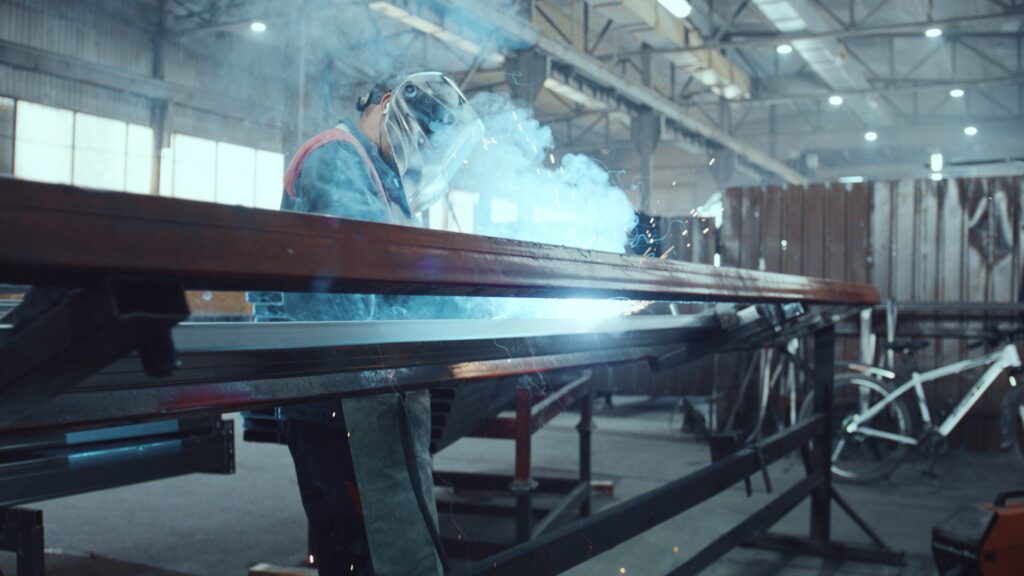
Integrated metal welding services combine fabrication, forming, and welding within a single controlled process to produce structurally sound welded assemblies. By maintaining process control and alignment from forming through welding, manufacturers improve structural welding performance, reduce variability, and ensure consistent assembly strength in high-volume OEM applications.
Key Benefits of Integrated Metal Welding Services
- Improved structural integrity across welded assemblies
- Consistent weld quality and repeatability
- Reduced variability between production runs
- Fewer defects and rework requirements
- Streamlined communication and process control
- Increased supply chain efficiency
Integrated welding manufacturing provides a controlled environment that supports reliable structural welding outcomes.
The Role of Welding in Metal Assemblies
Welding is a critical step in producing welded assemblies that must withstand mechanical loads, vibration, and environmental stress.
In OEM applications, structural welding is used to:
- Join formed and stamped components into final assemblies
- Maintain load-bearing integrity
- Ensure alignment and dimensional stability
- Support long-term durability and performance
Metal welding services directly influence the strength and reliability of the final product. Poor weld quality can compromise the entire assembly, regardless of how precise upstream processes are.
Risks of Outsourced or Fragmented Welding Processes
When welding is separated from forming and fabrication processes, variability increases and control decreases.
Common Risks in Fragmented Welding
- Inconsistent Fit-Up
Parts formed by one supplier may not align properly during welding at another facility. - Communication Gaps
Design intent and tolerances may not transfer accurately between vendors. - Quality Variability
Differences in welding techniques, equipment, and standards lead to inconsistent results. - Increased Lead Times
Additional logistics and coordination slow production.
These issues increase risk for sourcing teams and reduce confidence in the structural performance of welded assemblies.
How Integrated Welding Improves Structural Strength and Consistency
Integrated welding manufacturing aligns forming, fabrication, and welding processes under a single system. This improves both structural performance and repeatability.
Structural Advantages of Integrated Welding
- Improved Joint Integrity
Controlled fit-up ensures stronger weld penetration and bonding. - Consistent Load Performance
Uniform weld quality supports predictable structural behavior. - Reduced Residual Stress
Coordinated processes minimize distortion and deformation. - Better Dimensional Accuracy
Alignment is maintained throughout production.
By integrating metal welding services, manufacturers achieve higher assembly strength metal performance across all production runs.
Welding Quality Control and Process Consistency
Welding quality control is essential for maintaining consistency in welded assemblies. Integrated environments allow for tighter monitoring and standardization.
Key Elements of Welding Quality Control
- Standardized welding procedures and parameters
- Controlled material handling and preparation
- Continuous inspection during production
- Documentation and traceability of weld processes
These controls ensure that structural welding meets both engineering specifications and performance requirements.
Consistency in fabrication welding services reduces defects and improves overall product reliability.
How Welded Assemblies Are Produced
Integrated metal welding services follow a structured process to ensure quality and consistency.
Step-by-Step Welding Process
- Component Preparation
Formed and stamped parts are prepared with precise dimensions. - Fit-Up and Alignment
Components are positioned to ensure proper joint configuration. - Welding Operation
Controlled welding processes are applied to join components. - Inspection and Verification
Welds are inspected for strength, penetration, and quality. - Post-Weld Processing
Assemblies may undergo finishing or additional fabrication steps.
This process ensures that welded assemblies meet structural and dimensional requirements.
Impact on Assembly Strength and Performance
The strength of a welded assembly depends on both the welding process and upstream part quality. Integrated welding manufacturing ensures that both factors are aligned.
Performance Benefits
- Increased load-bearing capacity
- Improved resistance to fatigue and stress
- Reduced failure rates in field applications
- Consistent performance across production batches
For OEM engineers, this translates to confidence in product performance. For sourcing teams, it reduces risk and variability.
Reducing Defects Through Integrated Welding
Defects in welding can lead to costly rework, scrap, and production delays.
Common Welding Defects
- Incomplete penetration
- Porosity
- Misalignment
- Cracking
Integrated metal welding services reduce these issues by:
- Controlling process variables
- Ensuring consistent part geometry
- Standardizing welding procedures
This reduces variability and improves overall efficiency in fabrication welding services.
Supporting High-Volume Welded Assemblies
High-volume OEM production requires consistent output across large quantities. Integrated welding manufacturing supports scalability without sacrificing quality.
Key Advantages for High Volume
- Repeatable weld quality across batches
- Reduced variation in assembly strength metal performance
- Streamlined production flow
- Improved lead time reliability
These factors make metal welding services a critical component of scalable OEM manufacturing.
Mills Products’ Approach to Integrated Welding
Mills Products provides metal welding services as part of an integrated manufacturing system that includes roll forming, stamping, and fabrication.
Capabilities include:
- Precision welding for welded assemblies
- Process control to ensure repeatability
- Alignment between forming and welding operations
- Quality control systems for consistent output
This integrated approach supports structural welding performance and reduces variability across production runs.
For sourcing teams evaluating fabrication partners, this provides a reliable solution for producing high-quality welded assemblies.
FAQ: Metal Welding Services
What are metal welding services?
Metal welding services involve joining metal components to create welded assemblies with structural integrity and durability.
Why is integrated welding important?
Integrated welding manufacturing improves consistency, reduces variability, and ensures better alignment between forming and welding processes.
How does welding affect structural performance?
Welding directly impacts joint strength, load capacity, and long-term durability of assemblies.
What are common risks of outsourced welding?
Risks include inconsistent quality, misalignment, communication gaps, and increased lead times.
How can welded assembly quality be improved?
By controlling processes, maintaining consistent tolerances, and integrating welding with upstream manufacturing operations.
Conclusion
Metal welding services play a critical role in determining the structural performance of welded assemblies. Integrated welding manufacturing improves consistency, reduces defects, and ensures reliable assembly strength across high-volume OEM production.
To evaluate your welded assembly requirements, submit an RFQ and review your project with Mills Products.